
 EN
EN
 AR
AR
 BG
BG
 DA
DA
 NL
NL
 FR
FR
 DE
DE
 HI
HI
 IT
IT
 JA
JA
 KO
KO
 NO
NO
 PL
PL
 PT
PT
 RO
RO
 RU
RU
 ES
ES
 SV
SV
 TL
TL
 ID
ID
 SK
SK
 SL
SL
 UK
UK
 VI
VI
 TH
TH
 TR
TR
 MS
MS
 BE
BE
 HY
HY
 AZ
AZ
 KA
KA
 BN
BN
 BS
BS
 EO
EO
 JW
JW
 LO
LO
 MN
MN
 NE
NE
 MY
MY
 KK
KK

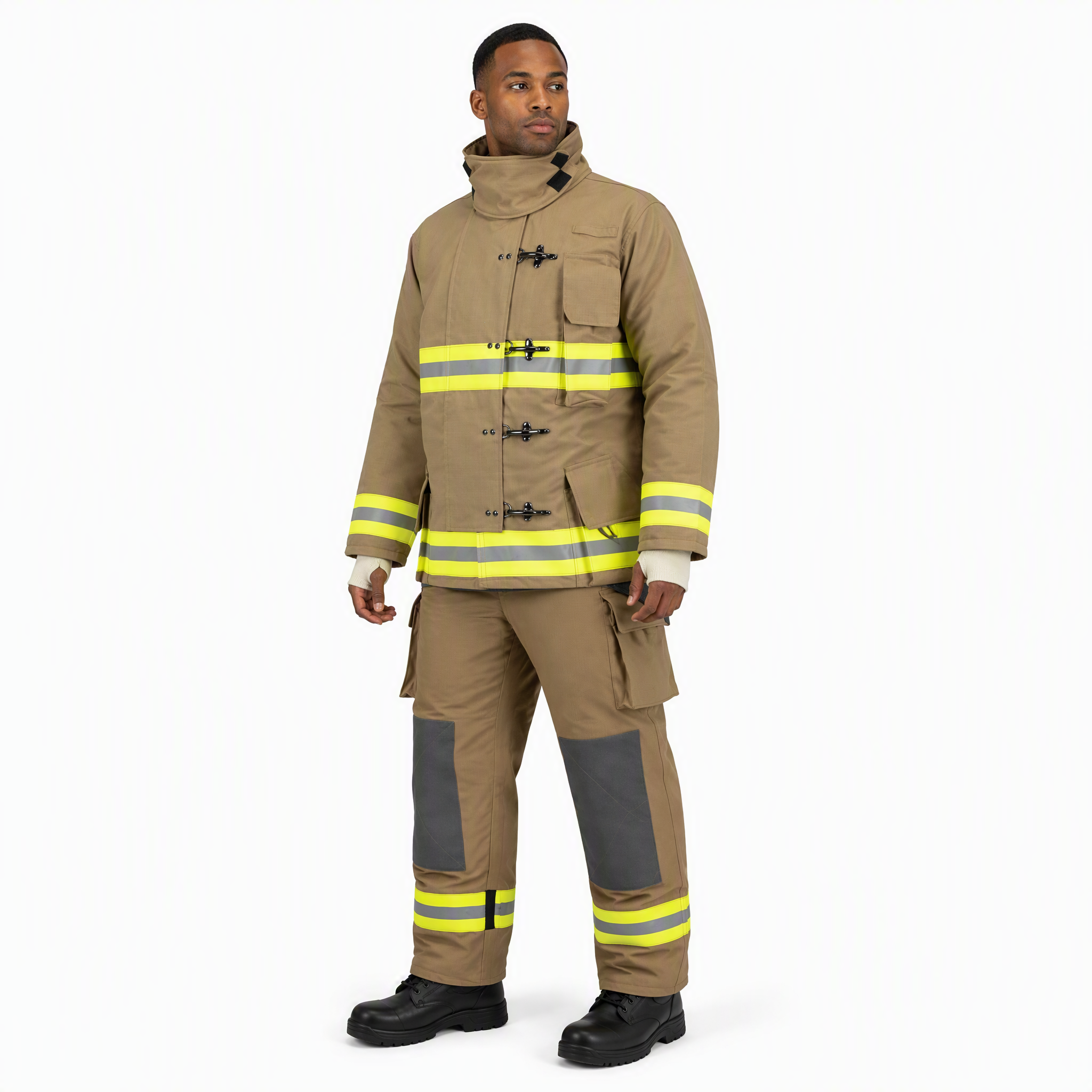
Picture this. Forty sets of turnout gear land at a fire department in Rotterdam. Every collar carries the EN 469 stamp. Then someone on the tender committee asks the only question that matters — Level 1 or Level 2 — and nobody in the room has the test report.
A standard number on a label is not a specification. EN 469 is a good standard, and a wide one. The difference between an entry-level suit and a Level 2 workhorse can sit behind the same four characters.
Level 1 and Level 2 are not two grades of the same thing
EN 469 splits structural firefighting clothing into two levels. Level 1 covers outdoor work: firefighting in vegetation, water supply, traffic control, site clearance. Level 2 is the structural level — flashover, interior attack, vehicle fires, chemical plant fires.
If your end user's tender mentions interior firefighting, shipping Level 1 gear is not a quality problem. It is a liability problem. Level 2 is what most municipal brigades order, and it is what aramid and PBI blends are built to reach.
Decode the X, Y, Z before you compare prices
The label codes carry the real numbers:
- X — heat transfer, split into Xf (convective) and Xr (radiant).
- Y — resistance to water penetration. At Y2, the benchmark is resistance to at least 20 kPa of hydrostatic pressure.
- Z — water vapour resistance, the breathability side. Z2 caps Ret at 30 m²Pa/W. Lower is better. This is the number that decides whether a firefighter can work a second hour without overheating.
Two suppliers can both print "EN 469" and sit three levels apart on Z. Ask for the actual measured values, not the level.
"180°C for ten minutes" is the floor, not a selling point
Heat resistance testing puts the material in an oven at 180°C for 10 minutes. It must not melt, drip or ignite, and shrinkage has to stay within 5%. Every compliant fabric clears this. It tells you the suit will not fall apart. It says nothing about how long a firefighter has before a second-degree burn — that is what Xf and Xr measure.
The membrane is where cost quietly disappears
In a three-layer build, the outer shell takes the flame, the thermal liner holds the air, and the moisture barrier does the invisible work. PTFE laminates give the best breathability. PU and TPU FR membranes are cheaper and can still be compliant, but the Z value drifts, and after repeated industrial washing the gap widens. If your customer washes gear in-house, ask for the after-wash numbers.
The US rulebook changed under everyone's feet
In September 2024 the NFPA published NFPA 1970-2025, folding NFPA 1971, 1975, 1981, 1982 and 1983 into one document. The old benchmarks still get quoted: composite TPP of at least 35 — roughly 17.5 seconds to a second-degree burn — and THL of at least 205 W/m².
The 1970 edition eases some moisture barrier durability and breathability requirements, adds PFAS restrictions and a Restricted Substances List, and makes particulate-blocking hoods mandatory. If you are still quoting 2023 spec sheets into the US market, they need re-reading. PFAS rules are moving in Europe too, so ask your mill what the shell, membrane and liner are actually made of.
Six questions to put in writing before the PO
- Level 1 or Level 2 — and the test report that proves it.
- The Xf and Xr values, not just the X level.
- Y and Z values, plus the membrane material.
- Which ISO 17025 laboratory, and whether the report covers the three-layer composite or a single fabric.
- After-wash and shrinkage results.
- A PFAS statement for the destination market.
None of this is exotic. It is the difference between selling gear and absorbing returns.
Sources: EN 469:2020 standard breakdown · NFPA 1970-2025 vs NFPA 1971-2018 · NFPA 1971 performance requirements